


Picture this.
Your team spent three weeks building the analysis. The model is airtight. The slides are clean. The narrative flows. You walk into the executive meeting confident.
Four minutes in, the CFO says: “I’m not sure this is the right direction.”
The room shifts. Someone nods. The conversation moves somewhere else entirely. You leave without a decision — and with a follow-up request that adds another two weeks to the project.
Here’s what went wrong: nothing in the meeting.
Everything that broke had already broken before you walked through the door.
The real dynamic in executive decision meetings
Most finance professionals treat a decision meeting as the place where a decision gets made.
It isn’t.
Executive meetings are where decisions get ratified — or stalled. The actual decision-making happens in the corridors, the 1:1s, and the five-minute conversations before someone pulls up the agenda.
This is not cynicism. This is organisational physics.
People with authority rarely change their minds in public. They change their minds in private — when there’s no status risk, no audience, and enough time to think. By the time they’re sitting across from your waterfall chart, they’ve already formed a view. Your job in that room is to speak to a position they already hold, or give them a new piece of information that’s compelling enough to shift it.
If you haven’t done the pre-work, you are hoping they’ll change their mind publicly.
They almost never will.
Why finance teams skip the pre-work
It’s not laziness. It’s three structural habits:
We equate effort with the model. The analysis is where the intellectual work lives, so that’s where time goes. Pre-meeting conversations feel like admin — not finance.
We assume the slides speak for themselves. We built them. We know what they say. So we assume everyone else will understand them the same way we do.
We confuse presenting with influencing. Presenting is putting information in front of someone. Influencing is connecting that information to a decision they already care about. They require completely different preparation.
The result: brilliant analysis, delivered to a room that was never ready to receive it.
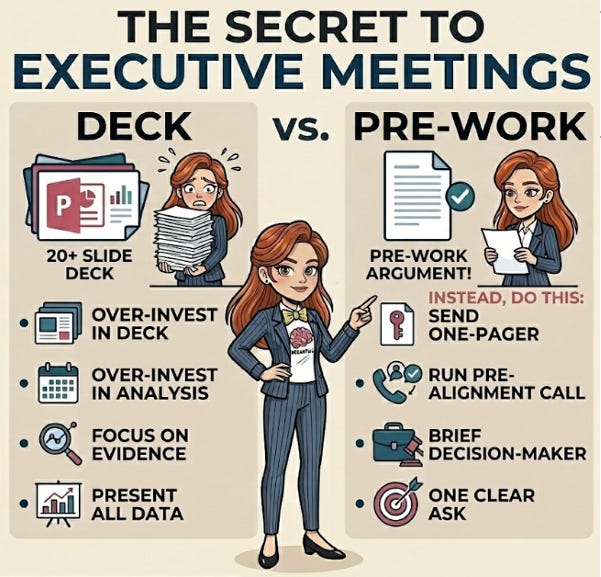
The Pre-Meeting Playbook — three tools
These are not elaborate processes. Each takes under 20 minutes. Together, they change the outcome of more meetings than any slide deck ever will.


The hidden power of the pre-alignment call
Of the three tools above, the pre-alignment call is the one most finance professionals resist — and the one that delivers the most return.
The resistance is understandable. It feels presumptuous. “Won’t they think I’m fishing for the answer?” No. What they think is: this person respects my time enough to do their homework before they get in front of me.
Here’s what the call actually does that no slide can:
It tells you the real agenda. Every executive carries into every meeting a list of concerns they didn’t put on the formal agenda. The pre-call surfaces those concerns before they derail yours.
It changes the room dynamics. When you’ve spoken to someone before the meeting, they become an implicit ally in the room rather than an evaluator. They already know where you’re going. They help steer others toward the same conclusion.
It compresses the decision cycle. Meetings where people are hearing something for the first time take longer, produce more questions, and are more likely to end without a decision. Pre-informed rooms move faster.
What this looks like in practice
Let’s say you’re presenting the Q1 management accounts with a recommendation to reduce discretionary spend by 8%.
Without pre-work: you present. The CFO raises a concern about cutting the marketing budget in a growth quarter. The Sales Director agrees with the CFO. The recommendation gets deferred to a working group. Three weeks later, nothing has moved.
With pre-work: three days before, you call the CFO. You learn that her concern is specifically about the marketing budget — everything else she’s aligned with. You adjust one slide to address that concern directly, and frame the recommendation as “an 8% reduction excluding demand generation.” You walk into the meeting, the CFO is already on side, and the recommendation passes in 12 minutes.
Same analysis. Same numbers. Completely different outcome.
This week’s action
Before your next executive presentation — identify the one person whose silent approval determines the outcome. Pick up the phone. Ask them one question: “What’s your biggest concern going into this?”
That’s it. The deck can wait.
Join my newsletter for more financial content!